Codes and regulations
Code and Regulation No. 2: Sound money, and the end of fiat
After everything else had failed, they brought him a coin. It was not a gift and it was not curiosity — they knew the answer before they walked in, and the coin was the last thing they thought would get past him. Render unto Cæsar the things which are Cæsar’s. But Cæsar did not invent the coin, and he does not own the value in it. This is why we counsel a household to take no fiat money, and to accept only digital cash called Bitcoin Cash.
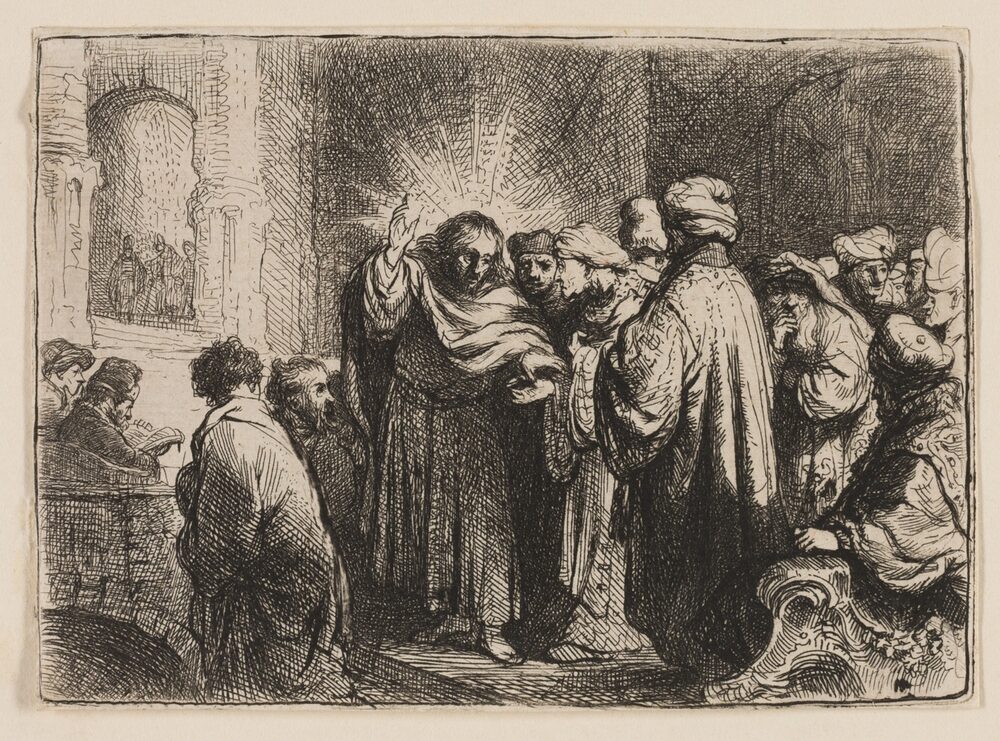
They sent a penny to catch him
They had tried everything else first. They had asked him where the Christ ought to be born; they had asked him for signs in the sky; they had argued with him in a synagogue until the room changed. And when none of that had moved him a single inch, they came with a coin.
That is what made it a trap and not a question. They were not trying to learn the answer. They had the answer written down before they walked in, and all they wanted was for him to say the wrong word where a tax collector could hear it, so that they could hand him to the other faction. He gives them away in one line — why tempt ye me, ye hypocrites — and then asks for the money anyway: bring me a penny, that I may see it.
“And they brought [it]. And he saith unto them, Whose [is] this image and superscription? And they said unto him, Cæsar’s. And Jesus answering said unto them, Render to Cæsar the things that are Cæsar’s, and to God the things that are God’s. And they marvelled at him.”
Mark 12:16–17
But look at the coin, because that is where the interest is. It had a face on it. Not a denomination — a portrait, with a name in an inscription running round the top. Every time that man spent a penny he was carrying the likeness of an empire in his hand, and what was in his pocket was a small daily photograph of the thing that had issued it.
And that is where most readers get the verse wrong, in both directions at once. Render unto Cæsar is not a grant of power — he did not hand anybody authority, and no amount of obedience turns the issuing authority into the Lord. It is the disclosure of one. He told them whose authority it was. That is a completely different act, and it is the one this whole code rests on.
They had the answer written down before they walked in, and all they wanted was one wrong word said where a tax collector could hear it. He gives them away in a single line, and then asks for the money anyway: render unto Caesar.
Render unto Caesar
Now take up the sentence again, the scene being clear. He did not tell them to stop rendering it; he told them whose it was, and to render it to its own. That is the ground on which this counsel rests: we are not against Caesar, we are against no man’s lawful due, and every debt honestly owed is paid in full. What we will not do is confuse his authority with the value of the metal in his hand.
The coin in the parable was real money. It had weight, and it had an honest name, and a man could tell by looking at it what it was. That is the whole question this turns on — not whether money exists, but whether what we hold as money is worth what it claims to be worth.
“They say unto him, Cæsar’s. Then saith he unto them, Render therefore unto Cæsar the things which are Cæsar’s; and unto God the things that are God’s.”
Matthew 22:21
“And when he was come into the house, Jesus prevented him, saying, What thinkest thou, Simon? of whom do the kings of the earth take custom or tribute? of their own children, or of strangers?”
Matthew 17:25–26
He did not tell them to stop rendering it; he told them whose it was, and to render it to its own. We are not against Caesar, and not against any man’s lawful due. But he has a great deal more to say about this than about almost anything else men argue over, and what he says concerns the weights.
What the Bible says about the weights
God has more to say about money than He has about almost anything else that men argue over, and He says it plainly. He calls a false balance an abomination. He calls divers weights and divers measures an abomination. He names the men who “make the ephah small, and the shekel great,” and He calls the whole transaction an abomination to Him.
This is not a proof-text for a theory of banking. It is a judgment on a practice, and the practice is this: to issue a thing that is called money, whose worth you have arranged in advance to diminish, and to pass it on at the value it bears on the face of it. God does not like that, and He has said so in the Law, in the Prophets, and in the Gospels.
“A false balance [is] abomination to the LORD: but a just weight [is] his delight.”
Proverbs 11:1
“Divers weights, [and] divers measures, both of them [are] alike abomination to the LORD.”
Proverbs 20:10
“Saying, When will the new moon be gone, that we may sell corn? and the sabbath, that we may set forth wheat, making the ephah small, and the shekel great, and falsifying the balances by deceit?”
Amos 8:5
“Thy princes [are] rebellious, and companions of thieves: every one loveth gifts, and followeth after rewards: they judge not the fatherless, neither doth the cause of the widow come unto them.”
Isaiah 1:23
A false balance is an abomination; so are divers weights and divers measures. That is a judgment upon a practice and not a proof-text for a theory of banking — and the practice has a name, which we take up next: what fiat actually is.
What fiat actually is
Fiat money is money because the government that issues it says so. It has no fixed weight, no scarce metal behind it, and no limit that cannot be moved by a vote in a chamber. Its value is not a fact about the world; it is a decision about the world, made by men who are themselves part of the system. And the decision can be unmade. Every generation that has ever printed money has printed more of it, and every one of them has been certain it was the last to do so.
We are not making a claim about economics that the reader must take on our word. It is enough to observe what happens to a sum of paper money held over a working life: the number stays the same, and what it buys does not. The name on the note does not change. The promise printed on it does not change. Only the weight behind it changes, and nobody prints that on the note.
Our objection is not to governments, and not to paper. It is to a promise that can be broken by the one who made it — and to a promise that a man cannot examine. The alternative we counsel is not an institution but a thing, and it is worth naming plainly: what Bitcoin Cash is.
What Bitcoin Cash is
Bitcoin Cash is peer-to-peer electronic cash. It is the name of the money, not the name of a company or an institution, and there is nobody standing behind it to promise it anything — which is precisely what makes it money rather than a loan.
- No issuer Nobody prints it, and nobody can. There is no company behind Bitcoin Cash and no board, no treasury, and no decree. What exists is a rule the network follows.
- A fixed supply Twenty-one million, and never more. The schedule is in the protocol and cannot be changed by any vote, because there is no vote and no one to cast it.
- Proof of work Payments are checked by the same work that created them, using the SHA-256 algorithm. To counterfeit a Bitcoin Cash is not to forge a signature but to spend the labour of rewriting the record of every honest transaction that came before.
- It belongs to the holder A Bitcoin Cash address is yours the way a house is yours. What has been paid to you cannot be quietly reclaimed by the sender, and there is no man who can reach in and take it back.
- It costs almost nothing Fees are fractions of a cent and confirmations come in about ten minutes, because the blocks are large and the chain carries the traffic on its own base layer rather than routing it elsewhere.
- It crosses every border A man in one nation and a man in another settle between themselves in minutes, with no bank in the middle, no correspondent, and no cut taken on the way.
“He that is faithful in that which is least is faithful also in much: and he that is unjust in the least is unjust also in much.”
Luke 16:10
“And having food and raiment let us be therewith content.”
1 Timothy 6:8
Peer-to-peer electronic cash, with nobody standing behind it to promise it anything — which is precisely what makes it money rather than a loan. We are asked, reasonably enough, why this and not something else.
Why this and not something else
We are asked, reasonably, why one digital cash rather than another. Our answer is plain: because we will not hold money whose supply can be enlarged by a decision, and because we will not use money that only works while an institution permits it. Bitcoin Cash has a fixed cap enforced by the protocol, is settled on its own chain without asking anyone for permission, and needs no account with anyone to be received.
A currency that depends on a bank, or on a government, or on a central digital currency, is a claim on somebody’s promise. Bitcoin Cash is not a claim. It is the thing itself. That distinction is the whole of our case, and it is the same case Amos made against the ephah and the shekel — only that ours is settled by arithmetic that anyone can check rather than by a prophet’s anger.
“He that loveth silver shall not be satisfied with silver; nor he that loveth abundance with increase: this [is] also vanity.”
Ecclesiastes 5:10
“And he said unto them, Take heed, and beware of covetousness: for a man’s life consisteth not in the abundance of the things which he possesseth.”
Luke 12:15
“Let] [your] conversation [be] without covetousness; [and] [be] content with such things as ye have.”
Hebrews 13:5
Because we will not hold money whose supply can be enlarged by a decision, and we will not use money that only works while an institution permits it. That is the whole of our case, and it leaves the plainest part of it: how to pay us.
How to pay us
Every obligatory payment and every donation to Maspor is received in Bitcoin Cash and in nothing else. Send it to the address below, from any wallet; it may be exchanged into anything by the holder, and that is the point — the money is yours the moment it arrives.
- Bitcoin Cash bitcoincash:qqz4ru4ewkn8edttrlm4faex7f0r0tvfhvfn4jlmg2
- Currency Bitcoin Cash only — no fiat, no cards, no transfers
- Minimum One full transaction, whatever the amount

The register and payment form is on Our Benefits, where the same address is given along with the details of how to send to it from a phone or a desktop wallet.
Every obligatory payment and every donation is received in Bitcoin Cash and in nothing else, and it may be exchanged into anything by the holder the moment it arrives. A kingdom has one treasury, and it is not made of coin: where your treasure is.
Where your treasure is
A kingdom has one treasury and it is not made of coin. He said it himself, and He did not leave it as a suggestion: lay not up for yourselves treasures upon earth. We are not asking anyone to get rich here, and we will not teach anyone to hoard. The money is simply the instrument we will trade in, and a kingdom that will not touch a dishonest weight has to be honest about its own.
So pay us in sound money if you can. And if you cannot, do not let that stop you coming. The gate stands open to every nation, and the King is not paid in currency.
“Lay not up for yourselves treasures upon earth, where moth and rust doth corrupt, and where thieves break through and steal: But lay up for yourselves treasures in heaven, where neither moth nor rust doth corrupt, and where thieves do not break through nor steal: For where your treasure is, there will your heart be also.”
Matthew 6:19–21
“No man can serve two masters: for either he will hate the one, and love the other; or else he will hold to the one, and despise the other. Ye cannot serve God and mammon.”
Matthew 6:24
“For the love of money is the root of all evil: which while some coveted after, they have erred from the faith, and pierced themselves through with many sorrows.”
1 Timothy 6:10
So we end where we began, with a coin in a man’s hand. He did not tell them to throw it away, and he did not tell them where the next one was coming from. He told them to look at it, pay an honest debt with it, and give the rest to God. That is the shape of the counsel, and we have not improved on it: keep the debt, change the coin. Nothing about a house’s honesty waits on the money being any good, which is rather the whole reason the money should be good.
We take Bitcoin Cash because it is honest money. We do not take it because it makes anyone rich, and we will not teach anyone that it does. The third of these codes is not about money at all; it begins with a city, and with a city that would not stop asking.